
Ajit Doval The Man Who Guards India from the Shadows
There are names that never appear in headlines, faces that never trend online, and careers that are measured not in applause but in crises quietly averted. Ajit Doval is one of those rare individuals — a man who has spent over five decades protecting a nation of 1.4 billion people, mostly in silence, and mostly without asking for recognition.
Yet today, Ajit Kumar Doval is one of India’s most recognized intelligence figures and his journey from a small village in Uttarakhand to the highest security office in the country is the kind of story that still feels difficult to believe — because it is so thoroughly, unmistakably real.
From the Hills of Pauri Garhwal
Born on 20 January 1945 in a village in Pauri Garhwal, in present-day Uttarakhand, Doval completed his education at Ajmer Military School, followed by Agra University where he earned a master’s degree in economics, and later the National Defence College.
There was nothing in his childhood that screamed “spymaster.” He grew up in a modest, vegetarian family in the hills. He studied economics. He had no obvious destiny written in stars. But he had something that would define his entire career — an extraordinary ability to read people, situations, and risks. He cleared the UPSC examination in 1968 and joined the Indian Police Service in the Kerala cadre.
What followed would be decades of work that most Indians would never hear about — not because it wasn’t important, but because that’s simply how intelligence work operates.
Seven Years Undercover in Pakistan
Ask anyone familiar with Ajit Doval’s career what defines it, and most will point to the same chapter: his seven years spent undercover inside Pakistan, working as a covert Intelligence Bureau operative. He embedded himself so deeply in Pakistani society that he reportedly even lived among ISI circles, gathering intelligence at enormous personal risk.
A 2025 web series titled Salakaar for JioHotstar was based on his covert operation in Pakistan in the 1970s – a small window into a chapter that has largely remained classified. That such a story is now being dramatized for Indian audiences speaks to how extraordinary those years were.
The series barely scratches the surface. The reality involved a young officer, far from home, operating in a hostile country, with no safety net. It required not just bravery but an almost superhuman capacity for calm — the ability to live a double life, day after day, year after year, without cracking.
He came back from Pakistan and never really stopped working.
Black Thunder, Mizoram, and the Art of Resolution
Doval’s career in domestic counter-terrorism is equally remarkable. He is widely credited for his role in Operation Black Thunder in 1988, the mission to flush out Khalistani militants who had taken over the Golden Temple in Amritsar. The operation was a success, accomplished with far less bloodshed than the catastrophic Operation Blue Star four years earlier. Doval’s intelligence work and negotiations were central to that outcome.
His success against Khalistani separatism during Operation Black Thunder was later featured on Epic TV’s show Adrishya.
He was also deeply involved in bringing insurgent groups in Mizoram to the negotiating table — patient, methodical work that helped end a violent conflict and bring a troubled state back into the mainstream. It is the kind of achievement that rarely gets a headline but reshapes millions of lives.
Throughout his career, he kept returning to one core belief: that the greatest dangers to a nation often come from within, not from outside its borders. According to Doval, the greatest threat to a nation’s security is not external aggression but internal vulnerability. He said it plainly: “India’s internal vulnerabilities are much higher than its external vulnerabilities.” It was not defeatism. It was the kind of hard-won clarity that only comes from years of watching how countries actually fall apart.
The NSA Who Changed India's Security Doctrine
In 2014, when Narendra Modi came to power, Ajit Doval was appointed India’s National Security Advisor. He has since become the longest-tenured NSA in India’s history, currently serving his third consecutive five-year term. During his second tenure, he was elevated to Cabinet rank.
The appointment was, in hindsight, a turning point in how India handled security threats. The era of strategic restraint — of absorbing terrorist attacks and responding diplomatically — began to give way to something more assertive.
India’s September 2016 surgical strikes and the February 2019 Balakot airstrikes were both conducted under Doval’s supervision. Both were unprecedented in modern Indian history — direct military responses to cross-border terrorism, carried out swiftly and without warning. India had crossed a threshold. The message to Pakistan was unmistakable: attacks would have consequences.
Then came the Doklam standoff with China in 2017, a nerve-wracking 73-day military face-off at a disputed Himalayan plateau. Doval is widely credited for resolving the Doklam standoff through diplomatic channels and negotiations — a crisis that could easily have spiralled into armed conflict, defused through back-channel dialogue and strategic patience.
Operation Sindoor: Precision Over Provocation
More recently, Doval coordinated Operation Sindoor, a series of precision airstrikes on terrorist camps located in Pakistan, which Indian officials described as “measured and non-escalatory,” aimed at neutralizing terrorist threats without provoking a broader conflict.
Speaking at the 62nd annual convocation of IIT Madras, Doval stated that the Indian Armed Forces executed precision strikes within 23 minutes, destroying terror camps including LeT and Hizbul Mujahideen bases in Pakistan and Pakistan-occupied Jammu and Kashmir. He pushed back firmly against foreign media narratives that suggested Pakistan had inflicted damage on India, asserting that not even a glass pane was broken on the Indian side and challenging international media to present credible evidence of any damage.
It was a rare public moment for a man who typically operates far from cameras — and it revealed the Doval that his colleagues have always known: direct, unapologetic, and entirely uninterested in diplomatic softening when he believes the truth is being distorted.
The Man Behind the Curtain
One of the more fascinating things about Ajit Doval is how deliberately he resists the trappings of modern visibility.
At the Viksit Bharat Young Leaders Dialogue 2026, when asked during a Q&A session about his use of technology, Doval confirmed that he does not use a mobile phone or the internet in his regular work. He explained that phones and the internet are not the only ways to communicate and that there are other methods most people are simply not aware of, adding that he only uses such tools in special situations — talking to family or connecting with people abroad.
In a world where politicians, bureaucrats, and officials of every rank maintain Twitter accounts and give podcast interviews, here is India’s top security official telling a hall full of young people: I don’t have a smartphone. I don’t browse the internet. And I’m doing fine.
He has no social media presence. He doesn’t court the press. When he does speak publicly, it tends to be at institutions — IIT convocations, youth dialogues, defence academies — where he addresses students with the kind of unhurried, grounded wisdom that comes from someone who has genuinely seen things most people cannot imagine.
In January 2026, Doval told young leaders that it is important to take the right and farsighted decisions at the right time, and advised them to think carefully about what the next two steps will be before taking the first one. It sounds simple. From a man who spent years undercover in a hostile country, it carries a different weight entirely.
Still at the Table
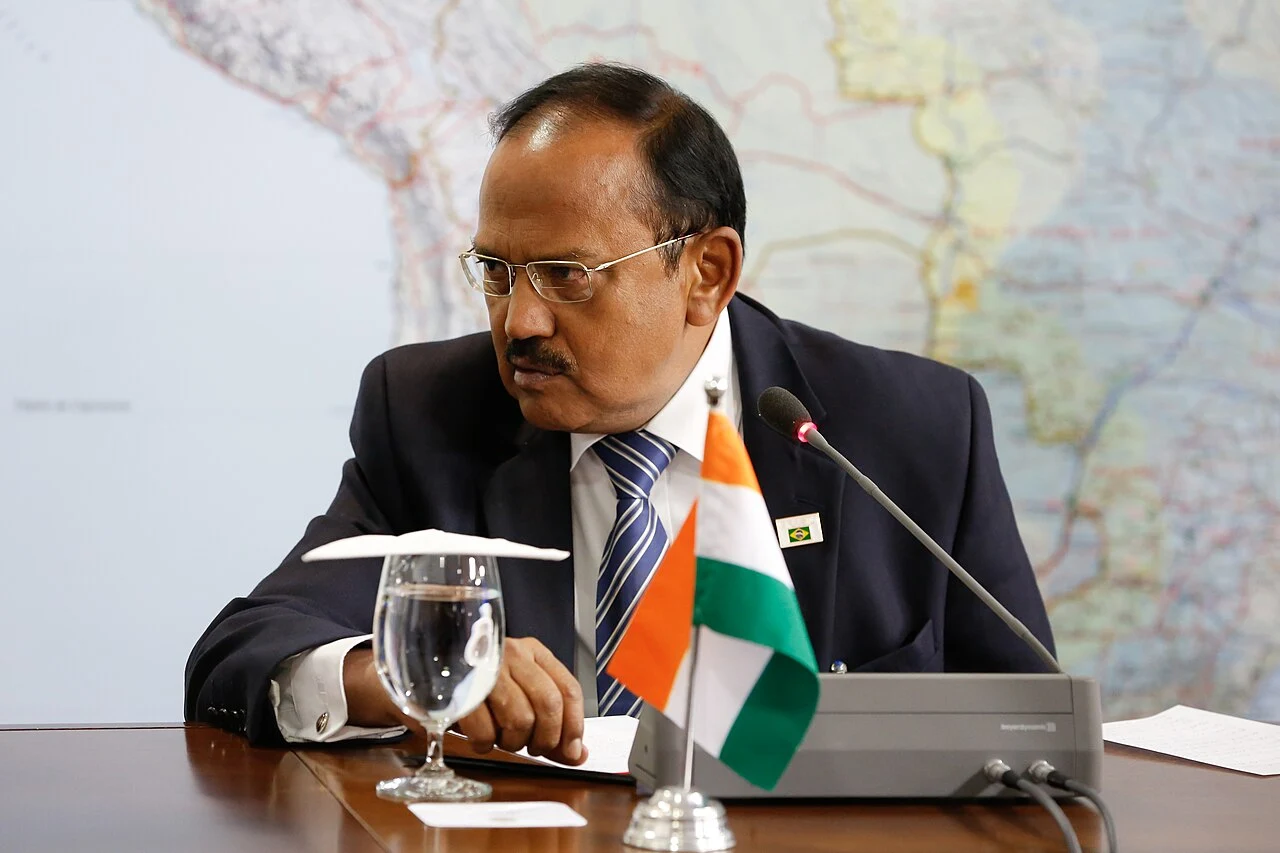
Even now, well into his eighth decade of life, Doval continues to hold talks with senior officials across the world — from Russian Security Council Secretary Sergey Shoigu on defence and energy cooperation, to meetings with China’s Foreign Minister Wang Yi on border issues, to co-chairing strategic dialogues with Brazil on defence and critical minerals.
This is the quiet reality of what Ajit Doval does every day: holding the threads of India’s security together across dozens of bilateral relationships, crisis points, and covert operations, most of which the public will never know about.
A Legacy Written in Silence
There is a certain kind of public servant who measures success by recognition — awards, ceremonies, profiles, applause. And then there is someone like Ajit Doval, who seems genuinely indifferent to all of it.
He has won the Police Medal, the President’s Police Medal, and the Kirti Chakra — India’s highest peacetime gallantry award — having become the youngest police officer in the country to receive it. The awards are real. But they sit quietly on a shelf somewhere. What drives him, you get the sense, is not the recognition but the work itself.
India’s security landscape today — the surgical strikes, the diplomatic engagements, the counter-terrorism doctrine — bears the unmistakable imprint of one man’s philosophy: that strength and restraint are not opposites, that intelligence is more powerful than firepower, and that the best victories are often the ones no one ever hears about.
Ajit Doval has spent a lifetime proving all three points. And he is, by all accounts, still at it.