Thorium-Based Nuclear Power | The Future of Clean Energy or an Overpromised Dream?
If you want to know about thorium based nuclear power then you have to know about thorium and how thorium able to comply india energy demand
What Is Thorium?
There’s a peculiar irony in nuclear energy’s story. For decades, the world fixated on uranium — a relatively rare, politically volatile, and weapons-capable fuel — while sitting on enormous reserves of a safer, more abundant alternative. That alternative is thorium-based nuclear power, and after being sidelined for over half a century, it’s finally getting a serious second look.
Thorium (symbol: Th, atomic number: 90) is a naturally occurring, mildly radioactive metal named after the Norse god of thunder. It sits in the actinide series of the periodic table, and at first glance, it doesn’t look like the saviour of clean energy. It’s a silvery-grey metal that tarnishes black in air — not exactly glamorous.
But what makes thorium genuinely interesting is its sheer abundance. It’s roughly three to four times more common than uranium in the Earth’s crust. Large deposits exist across the United States, Australia, Norway, Brazil, and — most significantly — India, which holds an estimated 25% of the world’s thorium reserves.
Fact | Figure |
Abundance vs. uranium | 3–4× more common |
India’s share of global reserves | ~25% |
Theoretical energy potential | Thousands of years of global supply |
Atomic number | 90 |
Thorium itself is not a fissile material — you can’t split a thorium atom directly to release energy the way you can with uranium-235. Instead, it’s what scientists call a fertile material. When thorium-232 absorbs a neutron, it transforms through a chain of decays into uranium-233, which is fissile and can sustain a nuclear chain reaction. That conversion process — and the reactor designs built around it — is where thorium’s story gets genuinely compelling.
How Thorium-Based Nuclear Power Actually Works
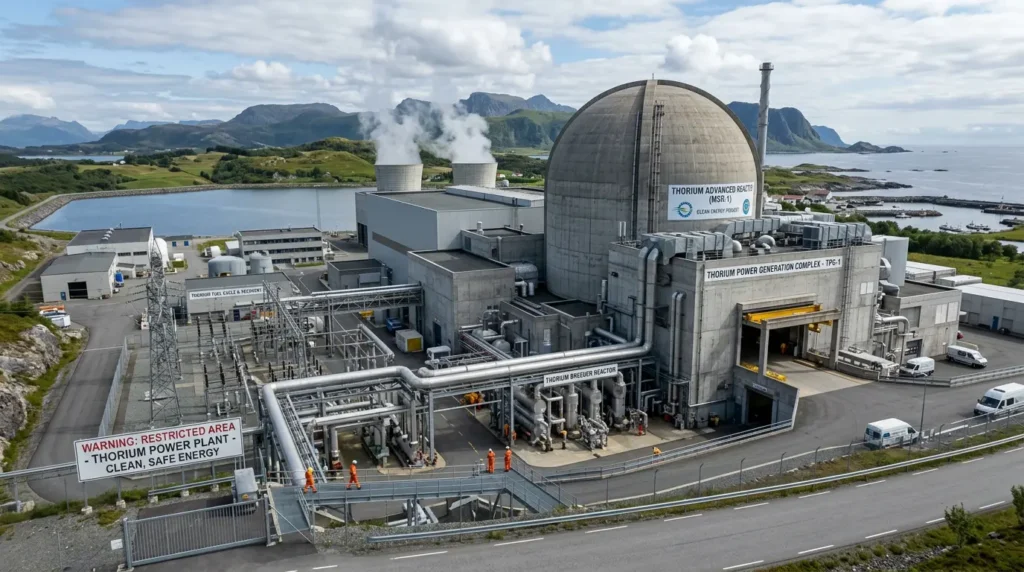
Most of the world’s nuclear plants today use Light Water Reactors (LWRs) burning uranium in solid fuel rods. Thorium-based nuclear power operates on a fundamentally different principle, and the most promising design is the Molten Salt Reactor (MSR).
The Molten Salt Reactor Design
In an MSR, thorium and a fissile “starter” fuel are dissolved directly into a liquid fluoride salt mixture at high temperatures — typically around 600–700°C. This salt acts simultaneously as the fuel carrier, the coolant, and the moderator. The reactor operates at atmospheric pressure (unlike conventional reactors which run at enormous pressure), and the liquid fuel can be continuously processed online.
Here’s why that matters: in a solid-fuel reactor, fission products gradually poison the reaction and fuel rods can only be replaced during shutdowns. In an MSR, you can remove those poisons continuously, maintain fuel efficiency, and theoretically operate for far longer without interruption.
“A molten salt reactor doesn’t melt down in the traditional sense — if it overheats, the fuel drains by gravity into a passively cooled tank. Physics, not pumps, is your safety system.”
The Thorium Fuel Cycle, Step by Step
- Thorium-232 is loaded into the reactor and bombarded with neutrons
- It absorbs a neutron and becomes Thorium-233
- Th-233 decays to Protactinium-233, then to Uranium-233
- U-233 undergoes fission, releasing energy and more neutrons
- Those neutrons breed more U-233 from thorium — a self-sustaining cycle
This is called the thorium-uranium fuel cycle. When designed as a breeder reactor, it can theoretically produce more fissile material than it consumes, dramatically extending energy output per tonne of raw material compared to conventional uranium reactors.
Thorium vs. Uranium — A Direct Comparison
Factor | Thorium Reactors | Uranium Reactors |
Fuel abundance | 3–4× more common | Limited, geopolitically concentrated |
Weapons proliferation risk | Very low | High — enrichment has dual-use potential |
Radioactive waste longevity | Centuries, not millennia | 100,000+ years of storage needed |
Meltdown risk | Passive gravity-drain safety | Requires active cooling systems |
Technology maturity | Early-stage | 70+ years of operational data |
Commercial cost | Unknown — no commercial scale yet | Well-established cost structures |
Existing infrastructure | Minimal supply chain | Global networks in place |
The picture is nuanced: thorium’s structural advantages are real and significant, but uranium’s head start in infrastructure, regulation, and operational experience is enormous.
Key Advantages of Thorium-Based Nuclear Power
1. Far Less Long-Lived Nuclear Waste
This is arguably thorium’s most underappreciated advantage. Conventional uranium reactors produce heavy, long-lived transuranic isotopes — some remaining radioactive for hundreds of thousands of years, creating effectively a permanent storage problem for civilisation.
Thorium MSRs produce vastly smaller quantities of these long-lived isotopes. Their waste becomes safe on the timescale of centuries rather than geological epochs. Some analyses suggest thorium waste requires secure storage for around 300–500 years, compared to over 100,000 years for uranium waste. That’s not a marginal improvement — it’s the difference between a multi-generational challenge and a civilisational one.
2. Dramatically Lower Proliferation Risk
The uranium-233 produced in thorium reactors is contaminated with uranium-232, which emits intense gamma radiation. This makes it extraordinarily difficult and dangerous to handle covertly, and makes any covert weapons programme far easier for intelligence agencies to detect remotely. It’s not a perfect barrier — but it’s a significant structural one that uranium and plutonium cycles simply don’t offer.
3. Passive, Physics-Based Safety
In a liquid fluoride thorium reactor (LFTR), the fuel sits above a frozen salt plug at the reactor’s base. If power is lost for any reason — including catastrophic accident — the plug melts (kept frozen by active cooling during normal operation), and liquid fuel drains by gravity into a passively cooled underground tank where the chain reaction stops.
No pumps. No operator action. No backup power required. Compare this to Fukushima Daiichi, where failure of backup generators to cool solid fuel rods after the 2011 tsunami caused a meltdown after the reactor had already been shut down.
4. Potential for Genuine Energy Abundance
Thorium’s abundance, combined with an efficient breeder cycle, opens the theoretical possibility of an energy source sustaining global civilisation for thousands of years. India — which has vast thorium deposits but limited uranium — has made this a literal national energy security strategy. Their three-stage nuclear programme culminates in thorium reactors as the long-term endgame.
The Real Challenges — Because There Are Several
Let’s be honest: thorium-based nuclear power has been “20 years away” for roughly 60 years. That’s not cynical exaggeration — it’s history. Oak Ridge National Laboratory ran a successful Molten Salt Reactor Experiment (MSRE) from 1965 to 1969, proving the concept worked. Then the programme was cancelled, largely because the Nixon administration prioritised reactors more useful for producing weapons-grade plutonium.
The main technical hurdles today:
- Corrosion: Fluoride salts at 700°C are highly aggressive. Developing alloys and materials that can withstand decades of exposure at commercial scale requires significant materials science development.
- Online reprocessing complexity: Continuously reprocessing radioactive liquid fuel is technically sophisticated and operationally demanding.
- The starter fuel problem: You need an existing fissile material (U-235, Pu-239) to “ignite” the thorium cycle before it becomes self-sustaining.
- Regulatory frameworks: Nuclear regulators in most countries have experience with light-water reactors. MSRs are a different technology with different failure modes and different safety arguments. Building regulatory confidence will take a decade or more.
- No commercial economics baseline: There’s no full-scale commercial thorium plant to benchmark costs against, creating significant investment uncertainty.
China’s experimental reactor — which achieved criticality in 2023 — is gathering precisely the operational data needed to work through these challenges systematically.
Global Progress | Who's Leading Thorium Development?
China 🇨🇳
China’s Thorium Molten Salt Reactor (TMSR) programme, based in Gansu province, is the world’s most advanced government-funded thorium effort. Their experimental 2MW reactor achieved first criticality in 2023 — the first MSR to operate since Oak Ridge in the 1960s. China aims to scale significantly by the early 2030s, with commercial deployment to follow. This is serious, funded, and operational.
India 🇮🇳
India has arguably the most coherent long-term thorium strategy of any nation. Their three-stage programme builds from pressurised heavy water reactors, to fast breeder reactors (now operational), to ultimately thorium-fuelled systems. With limited uranium and massive thorium deposits, this isn’t academic — it’s energy sovereignty planning spanning decades.
United States 🇺🇸
American activity is largely private-sector driven. Companies like Terrestrial Energy, Flibe Energy, and Kairos Power are developing MSR and fluoride-salt-cooled designs, some with Department of Energy funding. The regulatory pathway remains the largest single obstacle.
Europe 🇪🇺
The Netherlands, Norway, and Czech Republic have active thorium research programmes. The Dutch Delft University of Technology has been particularly active in thorium fuel cycle research, and European Commission funding has supported several collaborative efforts.
A Brief History of Thorium-Based Nuclear Power
Year | Milestone |
1950s | Thorium research begins at Oak Ridge National Laboratory; Alvin Weinberg champions MSR designs |
1965–1969 | Oak Ridge’s MSRE successfully operates, proving the concept works |
1972 | Nixon administration cancels thorium MSR programme; Weinberg is fired for advocacy |
2000s | Thorium renaissance begins; India commits to long-term strategy; Kirk Sorensen popularises LFTR concepts online |
2011 | Fukushima disaster revives global interest in passive-safety reactor designs |
2021 | China begins construction of experimental thorium MSR in Gansu province |
2023 | China’s TMSR achieves criticality — first MSR operation in 50+ years |
2026 | Multiple commercial MSR startups in licensing phases; China expands programme; India’s stage 3 groundwork advances |
The Verdict | Is Thorium-Based Nuclear Power Worth the Hype?
The measured answer is: yes, with patience.
Thorium-based nuclear power is not a near-term silver bullet for climate change, and anyone pitching it as such should be viewed sceptically. The technology needs another decade or two of real-world operational data, materials science development, regulatory framework building, and genuine commercial demonstration before it can meaningfully scale.
But the underlying physics is sound. The advantages — lower waste, lower proliferation risk, passive safety, fuel abundance — are real and significant. China’s operational reactor is gathering exactly the data needed to move from experiment to engineering. India’s structured programme is the most serious long-term national commitment to thorium in the world. And the private sector is, for the first time, seeing genuine commercial opportunity.
If the 20th century belonged to uranium by historical accident and weapons-programme priorities, the 21st-century thorium chapter may be written not by grand political decisions, but by the quieter, harder work of material scientists, reactor engineers, and regulators learning what this technology can actually do at scale.
That work is underway. The timeline is uncertain. But for the first time in fifty years, it isn’t theoretical.
Frequently Asked Questions About Thorium-Based Nuclear Power
Can thorium reactors be used to make nuclear weapons?
It’s far more difficult than with uranium or plutonium. The U-233 produced from thorium is contaminated with U-232, which emits intense gamma radiation detectable remotely. While not theoretically impossible, the practical barriers are significant, making thorium a substantially lower proliferation risk.
When will thorium power plants be commercially available?
Most realistic estimates point to the late 2030s or 2040s for first commercial-scale deployment, assuming China’s expanded programme proceeds and western regulators develop MSR-appropriate licensing frameworks.
Is thorium-based nuclear power safe?
MSR designs have inherent passive safety properties, including gravity-drain shutdown systems requiring no active cooling or operator intervention. They cannot melt down in the way conventional reactors can. However, commercial-scale operational safety data doesn’t yet exist.
Which country is leading thorium reactor development?
China is most advanced operationally, with its experimental TMSR in Gansu. India has the most comprehensive long-term national strategy. The US has the most active private-sector ecosystem, but faces significant regulatory hurdles.
How does thorium waste compare to uranium waste?
Thorium MSR waste requires an estimated 300–500 years of secure storage. Uranium waste requires over 100,000 years — a difference of roughly two orders of magnitude.